
Nigerian troops kill 50 Islamists after barracks assault
Abuja:
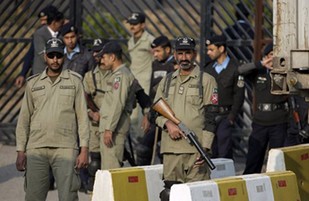
Nigeria's troops have killed over 50 Islamists and destroyed more
than 20 vehicles during a massive hunt for fleeing Boko Haram
insurgents who attacked an army barracks in a restive northeastern
town, a spokesman said. Boko Haram gunmen stormed the Mohammed Kur
Barracks in Bama early Friday, spraying it with bullets before
torching the compound.
Although a good number of
the insurgents escaped with bullet wounds while some have been
arrested, over 50 of them died in the course of exchange of fire
with ground troops in the ongoing operations to apprehend fleeing
terrorists," Major General Chris Olukolade said in a statement
yesterday. He said the military lost
15 soldiers, mostly from the attack, while some died during the
pursuit around the border with Cameroon. A total of five civilians
also died during the attack," he said. Olukolade said the
military destroyed over 20 vehicles conveying fleeing Boko Haram
fighters. "The vehicles were the
ones used during the attack on the barracks and were sited through
air surveillance as the terrorists were making efforts to cross the
borders back to their haven in Cameroun," he
said. He said the military would
continue to search for more insurgents who might be on the
run. Several Bama residents
told AFP the insurgents abducted several of the soldiers' wives and
children during Friday's attack. They said the attackers fled to
the nearby village of Abbaram, prompting the military to pursue
them. Olukolade said the families affected by the attacks had been
relocated to other military locations.In November, Human Rights
Watch reported that Boko Haram has increasingly used kidnappings as
a tactic, abducting scores of women and children this
year. The Bama attack was the
second major Islamist assault on the army this month, casting
further doubt on official claims that the rebels have been weakened
by a seven-month-old military offensive in the
northeast.
One year later, Japanese PM has big 'to do' list
Tokyo: A year after a landslide national election, Japanese Prime Minister Shinzo Abe is riding high as his plan to rescue the economy earns praise at home and abroad, but chinks in his armour are beginning to show. The unprecedented policy blitz, dubbed Abenomics, ushered in growth that led G7 nations in the first half of the year, stoked a sizzling stock market rally and offered a tantalising end to years of deflation.Then at the beginning of 2013 he declared that "Japan is back" in a speech to the New York Stock Exchange, saying his prescription of big government spending and monetary easing would reinvigorate the world's number-three economy. He embarked on a roadshow abroad to sell Brand Japan, including signing a nuclear reactor deal in Turkey and focussing on fast-growing economies in Southeast Asia
"This has been a very hectic year, travelling a lot overseas," Abe said in speech last week, adding he visited over two dozen countries since election night. His globetrotting burnished an image of a strong leader committed to getting things done in a country where the pace of policy is often glacial. And Tokyo's winning bid to host the 2020 Olympics gave national pride another shot in the arm, as well as promises of further economic benefits. "Abenomics definitely deserves praise," said Ivan Tselichtchev, economics professor at Niigata University of Management. "It has greatly improved sentiment among investors and consumers which is a positive for economy." Applause for the two-time premier is a far cry from 2006 when his term ended in ignominy and illness after just a year in office. This time around, Abe's efforts are bearing fruit. His policies and those of his new central bank governor Haruhiko Kuroda helped sharply weaken the yen -- the unit has lost a fifth of its value against the dollar this year, giving a boost to exporters -- while the stock market has surged more than 50 percent to a six-year high. . An increase in pay packets is even more crucial ahead of a sales tax rise next year to 8.0 percent from 5.0 percent, a move aimed at shrinking Japan's huge national debt, proportionately the worst among wealthy nations. The International Monetary Fund, among others, has welcomed Tokyo's efforts to get its fiscal house in order, but the tax rise has stoked fears it will derail a recovery. The last sales tax rise, in 1997, foreshadowed the fall into deflation.

Pussy Riot women vow to fight on after release
Moscow:The two jailed
members of anti-Kremlin punk band Pussy Riot, whose imprisonment
prompted a wave of global outrage, walked free on Monday and
immediately vowed to fight injustice in Russian prisons. Maria
Alyokhina and Nadezhda Tolokonnikova were released two months early
under a Kremlin-backed amnesty after serving most of their two-year
sentences. They immediately slammed the measure as a publicity
stunt before the Olympic Games Russia will host in
February. "I don't think the amnesty is a humanitarian act, I
think it's a PR stunt," the 25-year-old Alyokhina
said. The pair, who both have
small children, and fellow activist Yekaterina Samutsevich were
convicted on charges of hooliganism motivated by religious hatred
after staging a "punk prayer" in an Orthodox cathedral in Moscow in
February 2012. During the event, they asked the Virgin Mary to get
rid of President Vladimir Putin.
Wearing fishnet stockings
despite temperatures of minus 25 degrees C (-13 F) and hair
perfectly coiffed, Tolokonnikova said her prison time only made her
more resolute in opposing Putin's rule. "I don't consider this time
wasted," the brunette said. "I became older, I saw the state from
within, I saw this totalitarian machine as it is." "Russia is built
on the model of a penal colony and that is why it is so important
to change the penal colonies today to change Russia," she said.
She pledged to defend
prisoners' rights along with bandmate Alyokhina, saying "we would
like to pursue a joint project together."Right now we will be
discussing the structure and format of this project," Tolokonnikova
said in an interview with Echo of Moscow
radio.
Tolokonnikova wants to
spend at least a week in Krasnoyarsk where her grandmother lives,
and Alyokhina planned to join her in the Siberian city on
Tuesday. A US State Department
official said Washington welcomed their release as it had been
"concerned by the disproportionate severity of the sentences
against the members of the Pussy Riot punk band. The verdict
underscored our concerns about the rule of law and restrictions on
freedom of expression in Russia." Alyokhina used her first
interview after her release to slam the amnesty as a mere publicity
"stunt", and said that she would have preferred to remain in prison
but wasn't given a choice. If I had a choice to refuse (the
amnesty), I would have, without a doubt," Alyokhina told Dozhd
television channel.
The
two women were freed three days after the shock release of
anti-Kremlin tycoon Mikhail Khodorkovsky, who spent more than a
decade behind bars. Alyokhina's release was marked by
the same kind of security as the secret operation that freed
Khodorkovsky, who was not seen after his release until he touched
down at a Berlin airport on Friday afternoon.
S Sudan's Kiir ready for talks with Machar 'without preconditions': US
Washington: South Sudan's President Salva Kiir has said he is ready for talks with rival Riek Machar "without preconditions" to end the violence there, the US special envoy to the country said Monday. Meanwhile, the US military deployed a special Marine Corps unit and aircraft to the Horn of Africa to prepare for possible further evacuations of Americans from South Sudan, where violence has raged for a week. Given the intensity of the fighting, the US government dispatched Donald Booth, who is the special envoy for both South Sudan and Sudan, to Juba, where he met Kiir"I had a frank and open discussion with President Salva Kiir," Booth told reporters in Washington via telephone from Juba. "Importantly, President Kiir committed to me that he was ready to begin talks with Riek Machar to end the crisis, without preconditions, as soon as his counterpart is willing." Booth said he met with a group of 11 senior figures in the ruling Sudan People's Liberation Movement "who remain detained in Juba." Kiir's government last week announced the arrest of 10 people, many of them former ministers, in connection with an investigation of an alleged coup attempt led by Machar against Kiir. "I can report that they are secure and well taken care of," Booth said."These individuals communicated to me their desire and their readiness to play a constructive role in ending the crisis through peaceful political dialogue and national reconciliation." Machar has accused Kiir of carrying out a vicious purge of his rivals. Vowing to oust Kiir, his forces have since seized the town of Bor, capital of the powder-keg eastern Jonglei state, as well as the town of Bentiu, capital of crucial oil-producing Unity state. South Sudan's army on Monday was poised for a major offensive against rebel forces, as the country slid towards civil war despite international peace efforts. The UN Security Council launched emergency talks on the situation later Monday. UN Secretary General Ban Ki-moon has called for the reinforcement of the UN mission in South Sudan. Ban has asked the Council to approve the deployment of an additional 5,500 soldiers, which would bring the total number to about 12,000. He also wants about 400 extra police to back up the 700 already in the country. Washington is now in the process of looking at the request and evaluating how we can be helpful and how we can do that as quickly as possible," a senior US official said on condition of anonymity.
Too embarrassing for AL grassroots-Partha Pratim Bhattacharjee
Many grassroots leaders of the ruling Awami League are embarrassed and shocked at the sharp rise in the wealth of some party lawmakers and former ministers over the last five years.They said the alleged corruption by a section of AL leaders had tainted the party's image, and organisational action should be taken against those who had amassed wealth by illegal means.The Daily Star yesterday talked to more than two dozen grassroots leaders, mostly presidents and general secretaries of AL district and upazila units.Different newspapers have been running reports on the steep increase in the wealth of the AL leaders on the basis of their wealth statements submitted to the Election Commission with applications for candidacy in the January 5 polls. The party top brass are also uncomfortable at the media reports on the wealth of party ministers, state ministers and MPs, said sources in the AL.The ruling party, however, will do nothing about it at this moment, as it is now more concerned about the January 5 polls and the opposition's agitation.The party chief [Sheikh Hasina] is aware of the issue and will take steps against them after the election. The corrupt ministers and state ministers might not be included in the next government," a senior AL leader told The Daily Star on condition of anonymity.Matiur Rahman, acting president of Sunamganj district AL, said, "Some of the ministers, state ministers and MPs have amassed wealth beyond belief, tarnishing the party's image." He added, “The Awami League is a party of Abdul Hamid Khan Bhashani, Bangabandhu and Shamsul Haque. This party is based on ideology, not business."Momtajul Islam, general secretary of Nilphamari district AL, said the leaders who had earned crores of taka illegally did great harm to the party."The grassroots leaders and activists are disappointed and have lost confidence in the party," he said.Slamming the ministers who amassed wealth by illegal means, Matin Sarker, general secretary of Mymensingh district AL, urged the party president to take organisational action against them after probing the corruption allegations.He said the party has to take the blame for their unethical activities. "Those who are loyal to Bangabandhu cannot support this." Shahin Chaklader, general secretary of Jessore district AL, said individuals, not the party, are to blame for such misdeeds."If any leader had gathered wealth illegally, the party should take action against him,” he added.Urging the party to go tough on the corrupt leaders, Abdul Wahab, general secretary of Sujanagar upazila AL in Pabna, said the party must not spare those who would be found guilty of indulging in corruption. "As a member of the Awami League, I don't support this."Ishak Ali Sarker, president of Birol upazila AL in Dinajpur, said the party should look into the sources of income of every AL minister. Stressing the need for a law to make it mandatory for ministers and MPs to publish wealth statements ever year, Mohammad Ali Khasru, general secretary of Sandwip upazila AL, said the party ministers who made money by abusing power had betrayed the party chief.
The AL's image would be damaged for these ministers, he said.Humayun Kabir, acting general secretary of Companiganj upazila AL in Sylhet, said though a section of leaders were involved in corruption, the whole party would now have to pay the price.



